


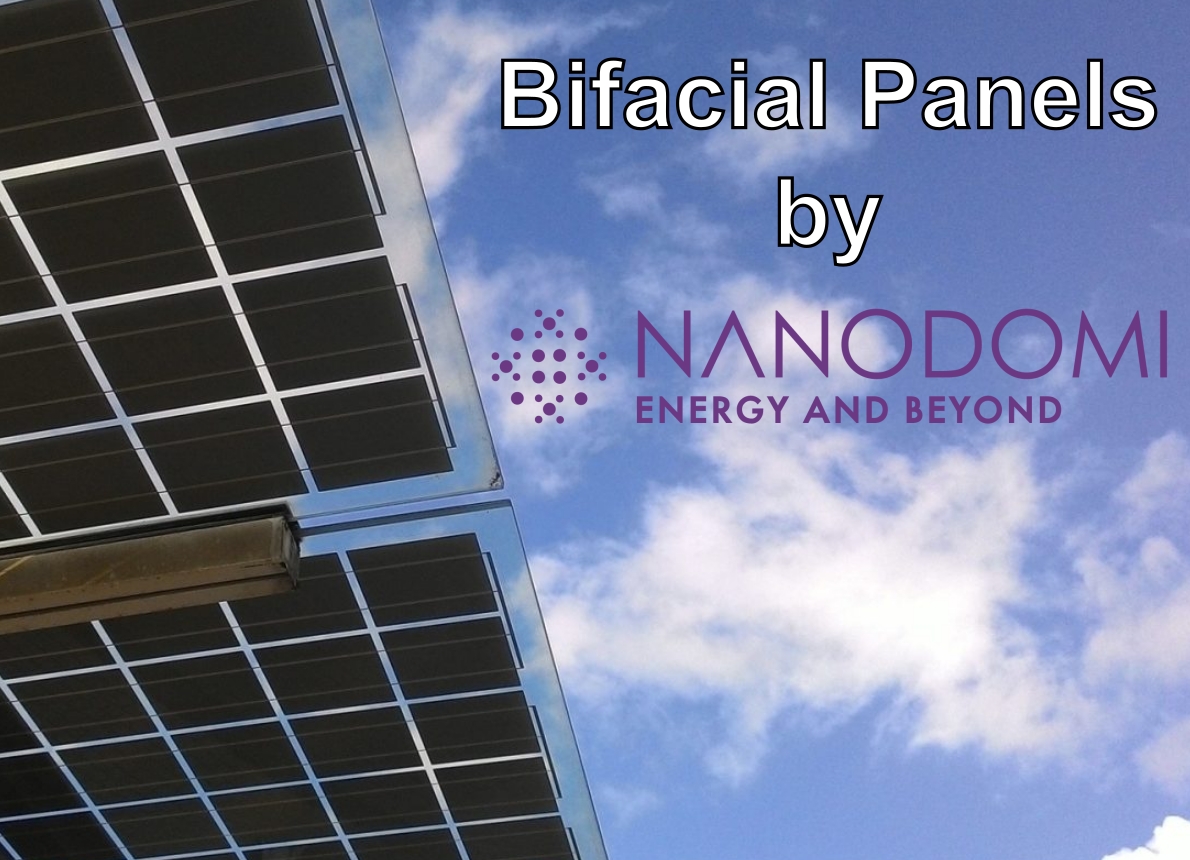
Bifacial panels can significantly increase energy production, and their market share is expected to grow rapidly.
What are bifacial solar panels (double-sided solar modules)?
Traditional panels operate exclusively using their front side when exposed to sunlight. In contrast, bifacial solar panels generate and capture electricity from both surfaces, the front and the back. As a result, they can produce additional energy ranging from 5% to 90% compared to the energy generated by the front side alone.
Currently, bifacial panels have almost the same cost as their monofacial counterparts. A bifacial photovoltaic panel typically consists of 60 or 72 solar cells. These cells feature an identical metal grid on both the front and rear sides, with more than 95% of both surfaces available for light capture and, consequently, electricity generation.
Bifacial panels come in different designs. Some are framed, while others are frameless. Some use double glass on both the front and back sides, while others have a transparent back sheet. Overall, most bifacial panels use monocrystalline cells, although polycrystalline versions also exist.
According to the International Technology Roadmap for Photovoltaics, bifacial panels currently hold a 20% market share, with forecasts suggesting this could rise to 70% by 2030.
How it works
It is important to clarify that the use of bifacial (BF) module technology does not increase the efficiency of the solar module itself, but rather the amount of solar energy collected per panel. By using bifacial solar panels, energy gains of up to 30% can be achieved, depending on factors such as the tilt angle, the reflectivity of the ground surface, the height above the ground, and many others.
The radiation collected by a panel consists of:
- Direct radiation from the sun.
- Indirect diffuse radiation caused by air particles, clouds, etc.
- Reflected radiation from surfaces near the solar installation.
Diffuse radiation can contribute significantly to the total amount of radiation absorbed by a panel; however, a large portion of it will not be captured in a tilted or horizontally installed module. Tilting the module increases the intensity of direct radiation, but reduces a significant part of the indirect component.
Indirect radiation has the same value regardless of its source. In contrast, reflected radiation depends on the nature of the surface surrounding the solar array, the tilt angle of the system, and other factors.
The front side of the panel receives both direct and diffuse radiation, the amount of which depends on the tilt angle of the module.
The rear side of the panel receives light from two sources:
- Near-field scattering: reflects direct and diffuse radiation.
- Diffuse radiation: non-reflected radiation coming directly from diffuse sources.
Advantages of bifacial solar panels:
- Increased efficiency / reduced installation space
Bifacial panels can capture and generate power from both sides. As a result, there is a total increase in energy production that can reach up to 30% compared to monofacial panels. In practical terms, this translates into less space required per watt, allowing the investor to install fewer panels to meet their energy needs. - Durability
Since bifacial solar panels are typically frameless and covered with glass on both sides, they are often more durable. The type of glass used in their construction is resistant to weather conditions as well as ultraviolet radiation, and it can withstand high temperatures and strong winds. - Aesthetically pleasing result.
Bifacial panels are available in many designs, including frameless ones. Many people find full-glass modules more aesthetically pleasing compared to single-sided solar panels. - Better performance in diffuse light
The additional surface (the rear side of the panel) means higher efficiency in diffuse light. - Performance optimization in projects installed on surfaces with high reflectivity.
- Greater independence from weather conditions
In the case of single-sided panels, solar energy production is strongly affected by bad weather. However, this is not the case with bifacial panels. In these panels, the front side is directly impacted by weather conditions, while the rear side continues to operate with less impact. - Reduction of the PID effect
- Installation angle
Unlike single-sided panels, a bifacial panel can be installed at any angle. They do not need to be positioned at a specific tilt for optimal performance. You can even install them at a 90° angle, and the performance will not be significantly affected.
NanoDomi’s recommendations for bifacial panels:
- Amerisolar AS-7M144-BHC 550W monocrystalline PV modules
- Μονοκρυσταλλικό ΦΒ πλαίσια Amerisolar AS-7M144-BHC 540W
- Μονοκρυσταλλικό ΦΒ πλαίσια AE Solar AE660ME-132DB BHC 660W Aurora Series
-
Μονοκρυσταλλικό ΦΒ πλαίσια AE Solar AE470TMC-144BDS BHC Double-Glass 470W Comet Series