

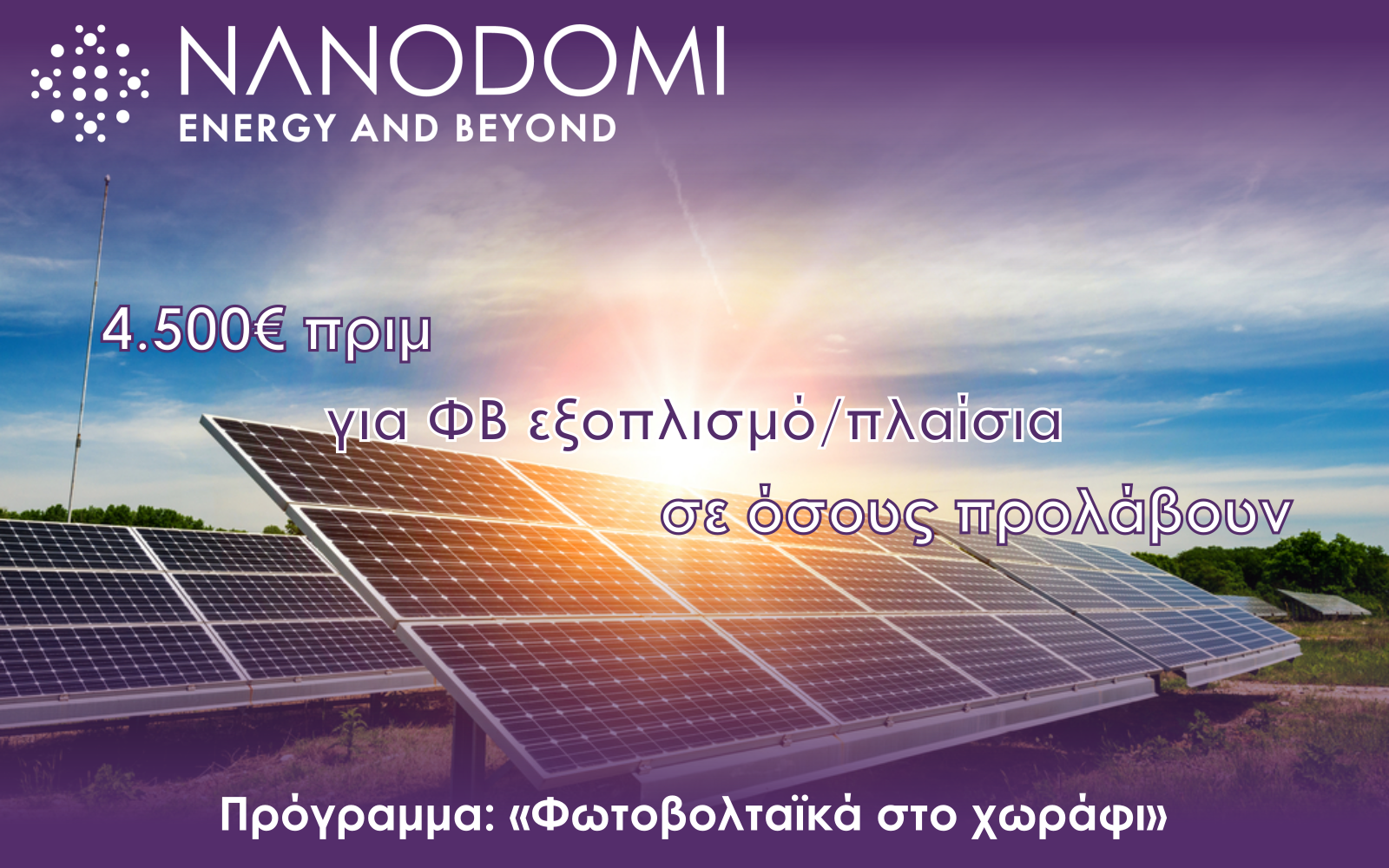
From Tuesday, April 9, the platform opens for submitting applications under the “Photovoltaics in the Field” program, with a €4,500 subsidy for those who manage to apply in time!!!
The application platform for the “Photovoltaics in the Field” program is now active, with amendments aimed at accommodating as many farmers as possible within the €30 million budget as well as the grid capacity of HEDNO (Hellenic Electricity Distribution Network Operator).
The measure subsidizes the installation of photovoltaic systems ranging from 10 kW to 50 kW. The planning prioritizes smaller 10 kW projects, where the subsidy is expected to reach close to €4,500 according to market prices.
Interested applicants will be able to submit their applications for grid connection until May 15, until the grid capacity gap of HEDNO (Hellenic Electricity Distribution Network Operator) is filled, which according to earlier announcements by the Ministry is expected to reach 1,250 MW.
However, this remains to be confirmed in practice, as the budget available to the organization is still unknown.
In any case, given the limited budget as well as grid capacity, a first-come, first-served priority order will be applied. However, priority will clearly be given to applications concerning small 10 kW photovoltaic systems.
With the cost for these systems not exceeding €11,000, the average subsidy is estimated to reach €4,500, meaning that the program can support approximately 6,700 applications.
This is also the intention of the Ministry, since Net-Metering has been secured only for such projects—namely, the energy netting scheme that allows the total energy produced by the renewable energy plant to be offset against the energy consumed by the farmer, without taking into account the timing of consumption.
This is also the intention of the Ministry, since Net-Metering has been secured only for such projects—namely, the energy netting scheme that allows the total energy produced by the renewable energy plant to be offset against the energy consumed by the farmer, without taking into account the timing of consumption.
The average annual yield of such a project corresponds to a production of 75,000 kWh per year on a field with a south-facing orientation, which in many cases—depending also on the pump motor—may result in an energy surplus.
For this reason, as reported by market insiders and sources from the Ministry, projects reaching this capacity will not be available to many.
For this reason, in such a scenario, the Ministry activates Net-Billing, also known as simultaneous netting. The aim is to establish a more restrictive framework, as the energy injected into the grid—due to the inability to match production and consumption in real time—is priced at a lower value (usually at wholesale levels, around 6.5 cents) compared to the price the consumer ultimately pays when their own production is not available to cover their needs.
For more information, please do not hesitate to contact us.
Address: Laskareos 21 & Ippokratous, Athens, 11472
Phone: +30 210 3629581
Ε-Μail: [email protected]