

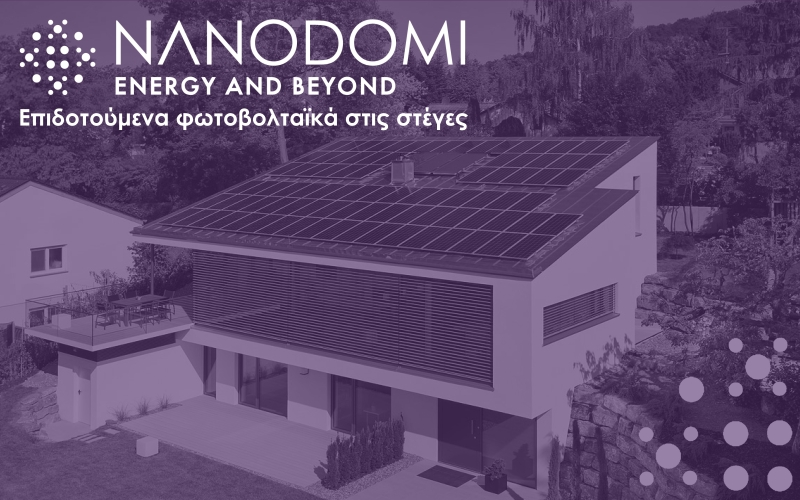
Key points of the Guide for subsidized rooftop photovoltaic systems for 300,000 beneficiaries – up to 7 kW for residential systems – and provisions for businesses and farmers.
Final details are being finalized by the Ministry of Environment and Energy for the “Rooftop Photovoltaics” program, in order to move into the final stage of its launch. Thus, according to energypress sources, barring any unforeseen issues, the pre-publication of the Guide is expected next week, so that interested applicants can prepare for submitting their applications.
At the same time, the HEDNO platform for submitting connection requests for net-metering systems is almost ready, with the process now significantly simplified. In fact, the platform may be activated as early as today by HEDNO, allowing interested parties to proceed with connection applications before the program officially begins.
However, the launch of the “Rooftop Photovoltaics” program also depends on the adoption of the draft law by the Ministry of Environment and Energy, which is currently under public consultation and concerns the transposition of an EU Directive on renewable energy sources. This is because the draft law includes a provision that will establish the implementation of similar subsidy programs for energy net-metering systems.
Indeed, as stated in the relevant provision, following the adoption of the bill, an implementing Ministerial Decision will be required to define the parameters of the “Rooftop Photovoltaics” program—such as its duration, as well as the maximum capacity limits for photovoltaic systems and batteries for each category of beneficiaries. In addition, for the program’s launch, the second HEDNO platform must also be fully ready, specifically the one for submitting applications for participation in the scheme.
Application submissions to start by mid-March.
The Minister of Environment and Energy, Kostas Skrekas, reiterated yesterday at an event that the submission of participation applications will begin by mid-March, although the timeline for completing the above steps is “tight.” The event was organized by the Piraeus Chamber of Commerce and Industry (PCCI), the Association of Industries of Attica and Piraeus (SVAP), and the investment forum A ENERGY.
In his address, Mr. Skrekas added that through the program approximately 300,000 households, farmers, and businesses will be subsidized for the installation of such systems, with a distribution of 40%, 30%, and 30%, respectively, within this “pool.” Therefore, support will be provided to around 120,000 residential systems, 90,000 agricultural systems, and 90,000 business systems.
A key reason for the increase in the number of beneficiaries to 300,000, compared to the 250,000 initially announced when the program was first presented, is the reduction of the maximum capacity of subsidized residential systems. Thus, instead of photovoltaic systems of up to 10 kW as initially foreseen, according to energypress sources, a household will now be eligible for support for the installation of a photovoltaic system with a maximum capacity of up to 7 kW, provided it has a three-phase connection.
In the case of a single-phase connection, the cap for the subsidized photovoltaic system will be 5 kW.
“Synchronization” of battery capacity with the PV system
In the case of residential installations, only photovoltaic systems combined with a battery will be eligible for subsidies. The minimum storage capacity will “follow” the capacity of the photovoltaic system. Therefore, if a household with a three-phase connection chooses to install a 7 kW photovoltaic system, it must be paired with a battery with a minimum capacity of 7 kWh.
In the same way, if a household has a single-phase connection and chooses to install a 5 kW photovoltaic system, it will be eligible for a subsidy for a battery with a minimum capacity of 5 kWh. Naturally, a similar “synchronization” will apply if, due to its consumption needs, a smaller system is installed—for example, 3 kW. In this case, the battery must have a minimum capacity of 3 kWh.
The subsidies will range from 40% to 60%, with the exact percentage for each household determined based on income criteria. In practice, the subsidy will cover 100% of the battery cost and a small portion of the photovoltaic system cost.
Residential systems (as well as those of other beneficiary categories) will operate under a net-metering scheme. The presence of a battery (at least in non-vulnerable households) will enable an increase in simultaneity, which in a typical household can reach up to 60%, compared to 30% with a “basic” photovoltaic system. Thus, thanks to the storage unit, a household will achieve even greater financial benefits, as for simultaneous production and consumption it will incur a lower charge, including regulated fees.
From the Ministry of Environment and Energy (YPEN), the systems for businesses.
To launch the program, €150 million have already been secured, while additional funds will be added over time. The scheme will also include a small separate budget specifically for vulnerable households.
In this case, the most likely scenario (which, however, has not yet been finalized) is that “simple” photovoltaic systems will be subsidized. If this option is confirmed, the subsidy rate for “simple” photovoltaic systems for KOT (Social Residential Tariff) beneficiaries will be 60%.
In addition to residential systems, the Ministry of Environment and Energy (YPEN) will also implement subsidies for agricultural net-metering systems. In this case, the maximum capacity will be 10 kW, with a subsidy of up to 40%, and the photovoltaic systems will not be accompanied by batteries. The reason is that they are intended for seasonal use (water pumps), meaning that energy storage would not be effective.
On the other hand, the sub-program for businesses is expected to be implemented by the Ministry of Development. In this category, the emerging framework (which has not yet been finalized) appears to favor subsidizing photovoltaic systems of up to 10 kW (without batteries) for small companies, operating under a net-metering scheme. There will also be support for larger-capacity photovoltaic systems with batteries for medium and large enterprises. Systems combined with batteries will operate on a zero-injection basis, meaning they will not feed electricity into the grid.